KORINTHIANS take A Major Walk on the wild side
Singer/guitarist Mattias De Backer talks to Nick Awde
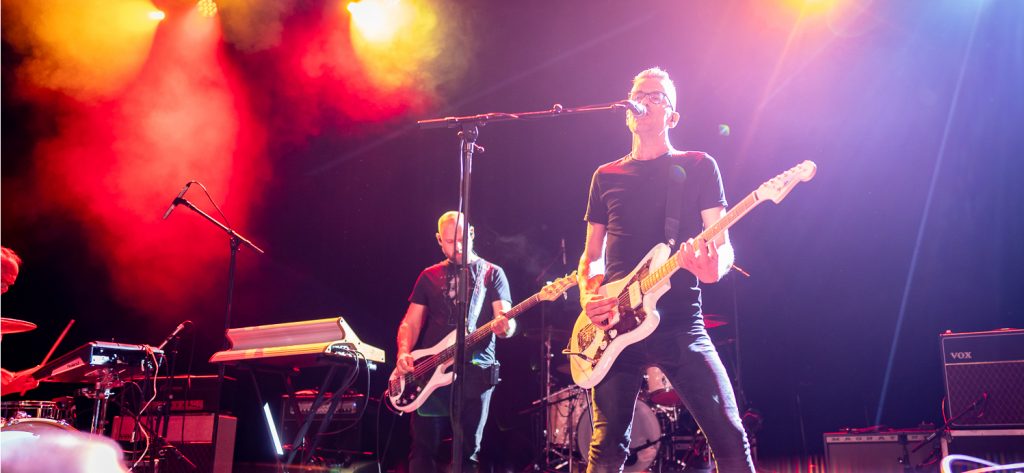
KORINTHIANS played Corrosion Fest 2023.
Alhambra Live’s next goth festival is Bats in the Attic, September 8-9.
Nick Awde: Tell us about the KORINTHIANS origin story. Was there a prequel?
Mattias De Backer: Indeed there was. Our bass player Ruben Masson and I played together for a much longer time before KORINTHIANS was formed. We started playing together like 20 years ago and we came from heavy guitar origins in a way. We played in KRAAI, which was a hardcore band – metal core – and then gradually we started making less extreme guitar music. Somewhere in that evolution I got into the new variants of new wave and post punk, not the original generations but the new versions. At the same time people in our audiences started telling me that my voice would sound good with an 80s music vibe going on behind it. So we sort of built the music around my voice from that moment onwards.
It makes no sense to force your voice into a corner where it doesn’t belong. That’s something I tried before and it didn’t work. With KORINTHIANS we turned the whole thing upside down, focused on the voice first. And if I look at this new generation of post punk and new wave in contemporary bands there’s so much interesting stuff going on, I’m very happy with the switch we made.
When we started the band in 2015, we were searching for our particular spot in the scene. We did an EP which was… well we’re not very happy about that one. But then in 2016 we recorded our first vinyl single ‘AWWW’ [‘A Way with Words’/‘Control’] which was when we also found Koenraad Foesters, the producer we’re still working with. So from that moment onwards I could say that that was the starting point of the band properly.
You’re based in Gent, which has always seemed to me to be Belgium’s best kept music secret – but which is now gradually revealing itself.
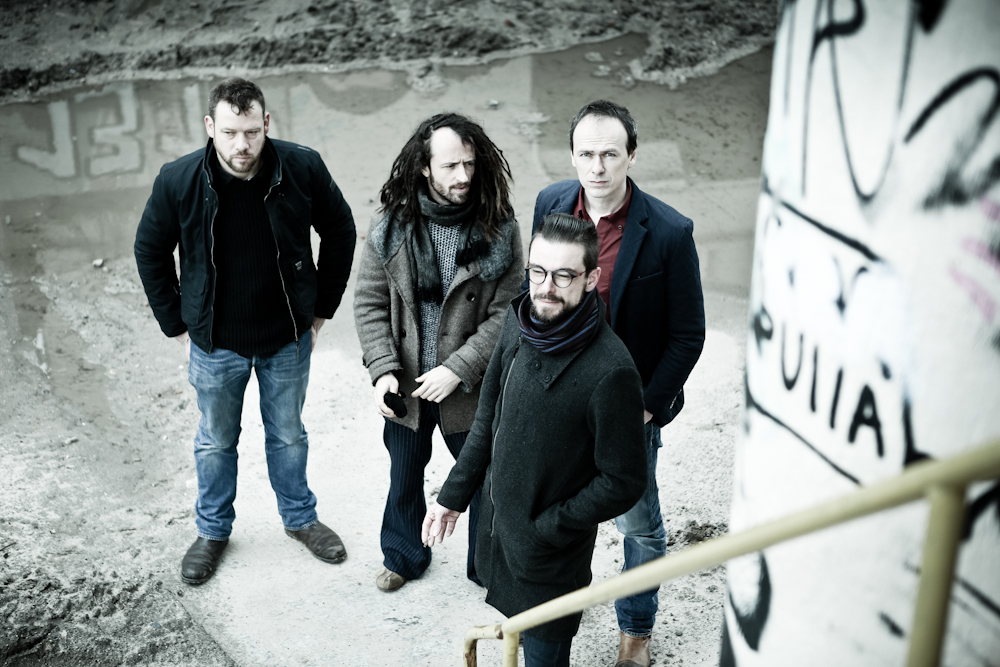
Three quarters of the band live in Gent – me, Ruben and keyboardist Jeroen Weckhuyzen – while drummer Kenny Voet lives in Sint-Niklaas which is not very far away.
Is there something in the water that makes it such a great hub not just for music but for culture in general?
Hmm, that’s a very good question. First of all, Gent has a long history of making music. It has received Unesco’s ‘City of Music’ status, part of the Unesco Creative Cities Network [in the UK Belfast, Glasgow and Liverpool are Cities of Music], which is not just because of the contemporary bands and the contemporary music scene but because of all the music that has been made here before that – so things like classical music are still quite something in Gent.
Apart from that, another reason why our city attracts musicians is the same reason it attracts people to come here in general. It’s a really nice place to live in because of the fact that it’s just large enough to have diversity but still small enough to feel cosy. If you want to summarise Belgian identity, let’s say ‘cosiness’ is probably one of the key words you would use. [laughs] Gent is really one of the cosiest cities you could imagine because it’s just large enough to be interesting and diverse and vibrant but not so big as Antwerp or Brussels.
Certainly there has been a wave of great guitar and techno bands and everything in between coming out of the city for quite some time now. That evident diversity must allow you to both experiment and fuse things together in quite a unique way.
That’s definitely the case. If you look at the contemporary music that is being made in Gent you see that a lot of it is about experimenting, trying new stuff, not really worrying about what is in vogue at this moment internationally. There’s something very authentic about what is being done here, like with the more heavy guitar-based bands you’re almost instantly hearing the moment of the music’s original creation.
And this hasn’t come out of nowhere…
No. You have amazing Gent bands like Future Old People Are Wizards, who weren’t very big but they did play in the clubs in Belgium and also a few tours internationally. There’s a similar vibe going on with [Flemish] bands from outside of Gent, like Brutus [from Leuven]who do very heavy music that’s also melodic because they compose in a clever way and do something with the sound. I don’t hear that kind of music coming from other countries.
Where are KORINTHIANS poised at the moment in terms of releases and gigs, given that bands are still coping with the long-term effects of Covid?
We released our debut album Chaos Control in 2019 just a few months before the pandemic, which was horrible timing obviously because we couldn’t promote it at all. Now in the month of May this year [2023], we have released our second album A Major Walk. Sales are going well and we’ve received quite a lot of press attention, so we’re really happy about that. Starting in September we have a whole series of shows lined up in Belgium, Netherlands, Germany and, for the first time, France. We’re looking into doing a few mini tours next year [2024] to try to combine our efforts a bit – go to Germany for a week, go to the UK for a week.
Tell us about the album. Was it a difficult gestation?
It was a very typical pandemic child. All of a sudden we couldn’t rehearse anymore, which meant that if we wanted to do anything at all we had to do it at home individually. So I was tinkering around in Ableton for some time and ended up focused entirely on making whole songs on my own, then sending the multi-tracks to the other members of the band so they could work on it and so on.
Basically the whole record was already programmed and composed in Ableton before we finally were able to get back into the rehearsal room after the pandemic. Which meant that for the first time this was a totally different way of working for us, to already have a very solid basis for each song before we started to rehearse them. In most cases I had also created a sort of blueprint for each instrument, so no one came with a blank sheet. They already had an idea of what would work and what would not, which allowed me as composer to have more control over the concept I had of the songs.
So even though the release year is 2023, A Major Walk is actually very much a pandemic album.
It is. Obviously the whole period of the pandemic and the lockdowns weren’t easy for so many people and creating the album was an effort and very frustrating a lot of the time. We’re really proud of A Major Walk because we managed to make something so good under those conditions. It talks about how frustrating that period was, where you couldn’t play anymore, couldn’t even play together, let alone play gigs anywhere, how we had just released an album that we couldn’t promote. So there’s that whole story running behind the songs.
Given that there’s a highly sonic landscape to KORINTHIANS’ music, how has that evolved with the new album?
In terms of sound, the challenge of composing music individually without the rest of the group via platforms such as Ableton has definitely shifted our focus towards a more synths and samples-based band rather than the slightly more guitar-driven sound we had on the first album.
This has definitely made a huge impact in the way how my guitar playing functions within the overall sound where the balance now is totally different. Initially I was a musician who composed music on guitar where the guitar was the backbone of the whole song, but now the guitar is simply an additional instrument that does a few moments of emphasis here and there that are necessary for making the sound we want rather than it being the actual backbone. So the guitar going to the margins is definitely something that has shifted things quite a lot.
In terms of lyrics there are a few songs that talk about the depressing state of politics, for instance our second single ‘No Future’ which talks about a guy sitting in a room that is on fire and he decides to carry on sitting there. By not going anywhere he becomes metaphor for a wider sentiment in the West. There’s also a song about the Black Lives Matter movement, ‘Mount’.
So there are a few comments in there on contemporary politics. But mostly my songs describe a simple scene as if in a short story which doesn’t necessarily have to do anything with the day-to-day news. It’s something that stands alone. To emphasize that narrative aspect a bit more, we asked a group of writers to write a short story alongside each lyric. So we now have an album that has an extra booklet with short stories going along with each of the songs.
From Gent how does the perspective of live music look? Do you see a live circuit picking up positively in Northwest Europe or is it still catching up with how things were before the pandemic?
It’s a bit of both. Definitely since the pandemic a few venues have closed and also quite a few festivals have stopped working. But on the other hand there are still entrepreneurial people who decide to start a new festival at this very crazy moment in time. So I have all the confidence that the whole thing will pick up as before, at least in the Belgian case. I know from colleagues in bands on the scene, for instance from Germany, that the situation can be very negative and it seems like people are still pushing the pause button.
In Belgium however you get the feeling that we’ve totally forgotten about the pandemic. Economically a few of the weak links so to speak have died, but all the rest has survived especially because the Belgian government did a good job in supporting the cultural sector. There was a lot of money going into culture in order to preserve its sustainability generally as organisations and individually as artists. So at least the cultural/creative sector in Belgium can be happy with that particular aspect of the work done by the government during the pandemic. It’s probably the reason why there hasn’t been a lot of bankruptcy or whatever in the sector.
So looking beyond Belgium’s borders, how do you see that venues/festivals gig circuit developing in the near future?
We have experience in playing in our own country and our neighboring countries, and you can see quite a lot of difference. In fact, the Netherlands doesn’t look really good for touring bands like us to be honest. At the moment they have quite an impoverished cultural sector because of cuts, so while there is some interest in KORINTHIANS in Netherlands, venues have quite some difficulty in finding the budget to book us. For instance, there is a policy where they get a subsidy for booking Dutch bands rather than other bands. In terms of scene it’s obvious that Germany has by far the biggest scene in terms of post punk and new wave, but the sort of music we make also seems to attract more attention in the UK than in Germany. So we are now in a bit of… well, not really a dilemma, but if we were to have only one bullet then we wouldn’t actually know in which direction to shoot.
It’s interesting to see how France is finally beginning to open up.
Indeed. That’s a really interesting story also from the internal perspective in Belgium, where it’s very hard for some reason to pass the language barrier and play in Wallonia as a Flemish band. And it’s probably the reverse effect as well for Walloon bands. By extension it’s proven to be difficult also to get access to France as a non-French speaking band – historically it’s logical that Walloon bands have far easier access to France.
But now all of a sudden we did an interview in French for the Frontière Rock radio show in France. My French isn’t perfect but good enough apparently to have an informed conversation. After it was broadcast we were contacted by somebody who does bookings in Paris – we were booked there for a show at L’International which is one of the classic venues there that does gigs in our scene. He also immediately connected us to a few other promoters in France. So I think that’s how it works. You first need to find some way to open the door and then you get to take your music to other places.
The thing is that from the perspective of an outsider the French do not have the same kind of vibrant post punk/new wave scene as other countries in Western Europe. It’s not helped by this phenomenon where the rural areas of France have been emptying up with everybody going to the cities or abroad. The result is a few places where there’s a very high concentration of stuff taking place and in other areas it’s simply a cultural desert where there are very few people to make up the audiences. So I don’t know how big the market is in those terms if we would be visiting France more often, but we are definitely open to it. It’s good to finally be able to play a show there. I just heard from our booking agent that they have also put Diamond Dog on their roster, which is a new French band [from Dijon]. So that that might also open up some doors for us too.
You spoke about the dilemma of choosing between Germany and the UK if you only had one bullet. Given the huge barriers created by Brexit to touring in both directions for UK and EU bands, how does this discourage bands in your position from coming over here?
Because we played at Corrosion Fest [March 2023 at Alhambra Live in Morecambe], we used that week to book a mini tour and we played four evenings in a row in the UK. Our booker wanted to use this opportunity to research for himself the current situation for his bands if they want to go to the UK, what do they have to do? It took him a lot of work to find out what we did and didn’t need to do.
There are a lot of guidelines that are vague and even after you’ve read them you still don’t know what you’re supposed to do. Then you ask people from the UK administration what we need to do and you get contradictory information. So it was total confusion, as if we were the first band ever to consider going to the UK!
That’s the British way – masters of legislation, amateurs of implementation.
Certainly we found it very difficult. Eventually we found out what we actually needed to do in terms of visas, passports, gear, merchandise and so on. We followed all the official regulations and it cost us a lot of money and then it turned out that nobody actually checked or bothered to even look at our documentation – they didn’t even look into the van to see what we had brought with us.
We had heard a lot of horror stories from other bands that went to the UK before us so we didn’t know what to expect. At the UK border you are definitely nervous because you don’t know if you have all the right documents with you and if they’re going to send you back. If they do, for whatever reason, you can say goodbye to your tour.
That’s a big source of stress for bands wanting to come to the UK, which you ordinarily want to avoid obviously. It’s already quite an effort to travel to another country to play a few gigs without all the hassle of having to cross that kind of border. So the UK is definitely not inviting.
But on the other hand, if you find out that there is great enthusiasm among fans regarding your music, then of course you have to go for it!